
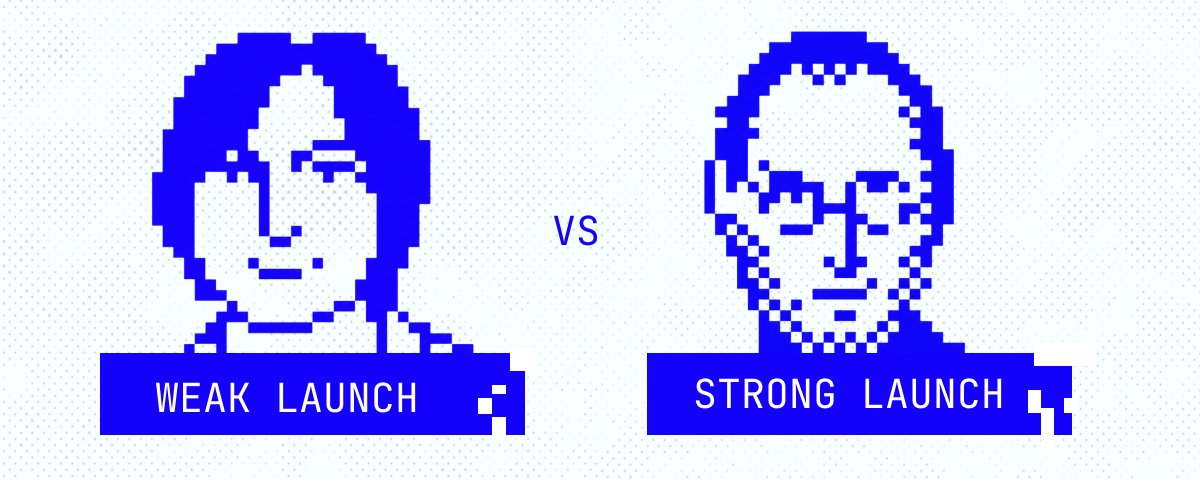
A strong launch video is not an expense. It is the one asset you use everywhere.
Launch day. Landing page. Ads. Cold emails. Investor updates.
A weak launch gets used once and forgotten. A strong one keeps selling for months.
Two startups, one week
Picture two AI startups launching in the same week. Same kind of product, same size of audience, same launch day.
The first one makes its video in an afternoon. AI voiceover, stock motion, a headline that says "Introducing the future of work." It ships, gets a polite round of likes, and disappears from the feed in a day.
The second one spends the first week on research and the second on the script. The animation comes last. The video opens with the exact problem users complain about, in their words. People watch it, share it, and sign up.
The product is the same. The launch is not. This article is about the gap between them.
What a weak launch looks like
A weak launch is made fast and made cheap, usually by feeding the product page into an AI tool and accepting the first output. Nothing in it is wrong. Nothing in it is specific either.
You can spot one in the first five seconds:
- The opening line could belong to any company. "Supercharge your workflow" fits a thousand products, so it describes none of them.
- It lists features instead of one problem. Four features in thirty seconds means the viewer remembers zero.
- The voiceover and visuals feel templated. Same stock rhythm, same gradient, same "AI-powered" badge as every other launch that week.
- Nobody talked to a user. The script is written from the founder's own pitch deck, not from what customers actually say.
- There is no point of view. It explains what the product is, never why it should exist.
The result is a video that is easy to ignore. It looks like an ad, so people treat it like an ad.
What a strong launch looks like
A strong launch is built in the opposite order. The decisions come first and the animation comes last.
Research.
Find out what the audience already says about the problem, and which launches in your space actually worked.
Analysis.
Decide the one promise, the one viewer and the one reason to care. Everything else is cut.
Script.
Write the first ten seconds before anything else, because that is where people decide to stay.
Craft.
Motion, sound and pacing serve the script. Small details are what make a video feel unlike an ad.
Results.
Track views, signups and replies, then fix what the numbers show.
Notice what is missing from that list: a tool. AI can help at any step. It cannot do the first three for you.
The research behind a strong launch
Research is the part nobody sees in the final video, and the part that decides whether it works. Before a single frame, we do five things:
- Read the customer's own words. Reviews, Reddit threads, support tickets and replies on X. The best hook is usually a sentence someone already typed.
- Study the top launches in the category. What did the best ones open with, and what do they all repeat that you can avoid?
- Find the one sharp promise. If the product has six benefits, we pick the one a stranger would pay attention to first.
- Check where the video will live. A launch for X, for a landing page and for a cold email each need a different first ten seconds.
- Define what counts as a result. Views, signups, demo bookings or replies. We decide before we animate, so we know what to measure after.
How we run a launch at Ganimate
The process is simple on purpose. You see the thinking before you pay for any animation.
A strategy call.
We learn the product, the audience and the one result you need from launch day.
Research and teardown.
We collect customer language and break down the strongest launches in your category.
Script first, and you approve it.
We write the first ten seconds and the full script, and nothing gets animated until you sign off.
Craft.
Motion, sound and pacing are built around the approved script, with the small details that keep it from feeling like an ad.
Cutdowns and launch kit.
We cut shorter versions for X, Reels and ads, so one video works in every place you post it.
Review.
After launch we look at views and signups together, then fix what the numbers show.
The script approval is the part founders like most. It means the risky decision, what to say, is settled before the expensive part starts.
Weak vs strong, side by side
A weak launch earns a few likes, then silence. A strong launch earns views, shares and signups you can trace.
AI is a tool, not the process
This is not an argument against AI. We use it every week, for rough storyboards, voice tests and faster iterations. The mistake is letting it make the decisions.
An AI tool will happily write a script for any product. It will not tell you which sentence your customers use, which promise a stranger cares about, or which detail makes a video feel human. That judgment is the part that cannot be generated, and it is the part that gets paid back.
The real cost of a cheap launch is not the video. It is the one launch day you do not get again, spent on something nobody remembers.
What strong launches have earned us
We have built launch videos for AI and tech startups at Ganimate, and the pattern holds. The work that started with research and a sharp script is the work that moved numbers.
None of those came from a template. Each one started with a question: what does this audience already care about, and what is the first thing we say to them?
A checklist before you ship your launch
Run your own launch through this list. Three or more "no" answers means it is closer to weak than strong.
- Does the first line name a specific problem, not a slogan?
- Did you use words your customers actually wrote or said?
- Can a stranger say what the product does after ten seconds?
- Does the video make one promise, not five?
- Did you study at least three launches in your category?
- Would it still feel like yours with the logo removed?
- Did you decide what result you are measuring before you published?
Cheap is easy. Clear is not.
Anyone can make a launch video now. Few will do the research that makes it work.